
When John White returned to Roanoke Island in August 1590, he expected to find his family and the settlers he had left behind three years earlier. Instead, he found an empty settlement and a single word that has haunted the story ever since: CROATOAN.
The colonists almost certainly did not simply vanish without a trace. The evidence suggests that they left Roanoke deliberately and may have divided into smaller groups, possibly moving toward Croatoan—today's Hatteras Island—and inland along Albemarle Sound. What happened to each individual after that remains unproven.
A Colony That Was Never Supposed to Stay at Roanoke
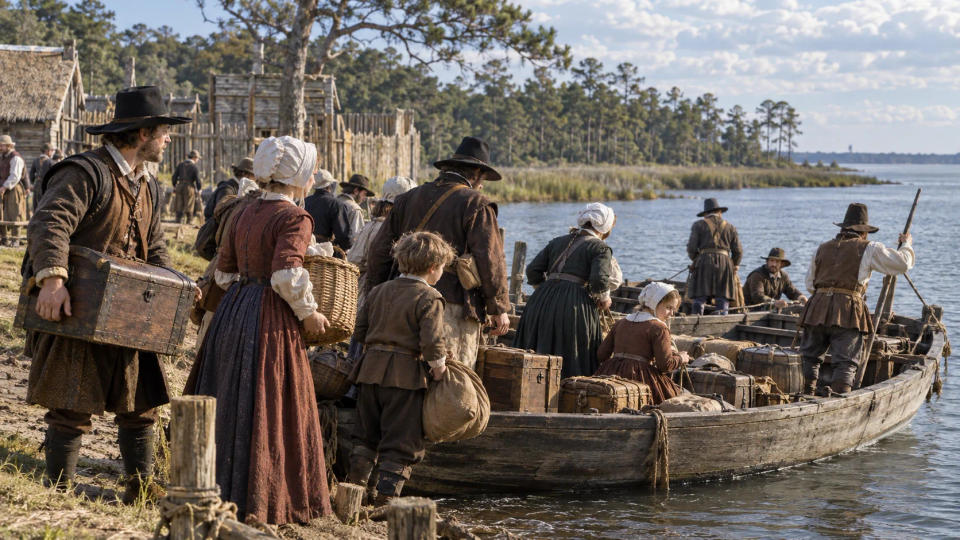
The 1587 expedition was part of Sir Walter Raleigh's effort to establish an English foothold in North America. John White led 118 men, women, and children across the Atlantic, but Roanoke Island was not meant to be their final home. The group intended to settle farther north near Chesapeake Bay and stopped at Roanoke to check on men left there by an earlier English expedition.
According to the National Park Service, the fleet's master, Simon Fernandes, refused to take the colonists farther north. The settlers therefore repaired abandoned buildings on Roanoke Island and tried to make the best of an unwanted situation. Their position quickly became difficult. Food supplies were uncertain, winter was approaching, and relations with nearby Algonquian communities were already strained by earlier English actions.

One of the most famous events of the colony occurred on August 18, 1587, when White's granddaughter Virginia Dare was born. She became the first child of English parents known to have been born in the English colonies of the Americas. Yet celebration did not solve the colony's practical problems. The settlers soon persuaded White to sail back to England for supplies and reinforcements.
Before he left, the colonists made plans for what they would do if conditions forced them to move. The National Park Service says they intended to split, with one group remaining on Roanoke and another searching inland for a better location. They also agreed to leave a message identifying where they had gone if the entire settlement moved.
What John White Found in 1590
White expected to return quickly, but war with Spain changed everything. England needed ships to defend itself during the crisis surrounding the Spanish Armada, and White could not secure a return voyage until 1590. By then, the colonists had been without reliable English support for three years.
He landed on Roanoke Island on August 18, 1590. The village was deserted. The houses had been taken down rather than smashed apart, and there was no obvious evidence of a battle. White found the letters CRO carved into a tree and CROATOAN carved into a post of the palisade.
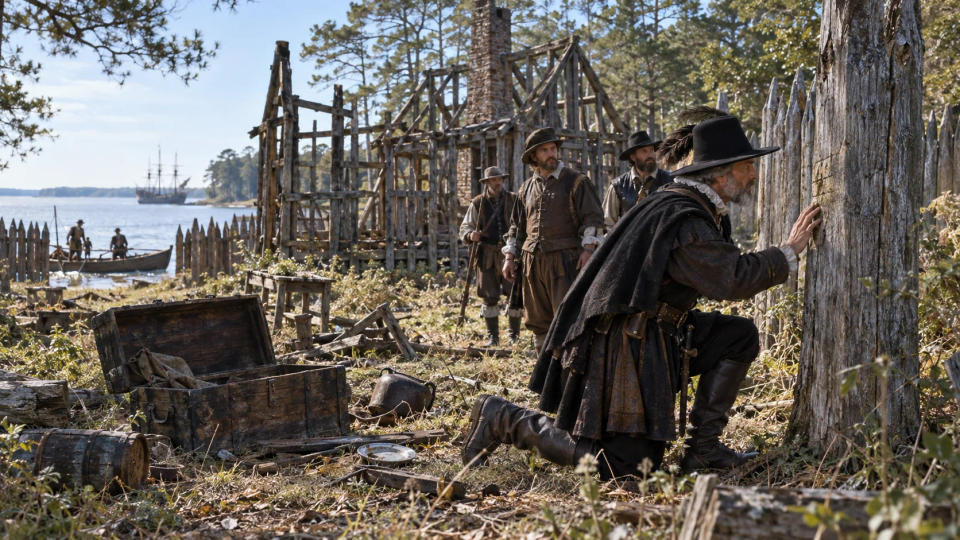
The message did not look like a mysterious code to White. Croatoan was the name of both an Indigenous community and the island where that community lived, roughly 50 miles to the south. White had also arranged for the settlers to add a special mark if they had left under extreme danger, and he reported no such distress sign. He therefore believed the carving pointed to their destination.
He tried to sail toward Croatoan, but bad weather and problems with the expedition forced the search to be abandoned. White returned to England without reaching the island and never learned what happened to his daughter, granddaughter, or the other settlers.
The Strongest Clues Point Away From Roanoke
For centuries, explanations ranged from massacre and disease to Spanish attack or destruction by a hurricane. None has been proved. One important detail works against the idea of a sudden disaster at the settlement itself: White described buildings that had been dismantled, not a community destroyed in place. There were also no graves or obvious traces of a violent last stand at Roanoke.
Croatoan remains one of the most important possibilities because the colonists themselves appear to have named it. Archaeologists working on Hatteras Island have found European material from the broader period, although trade and later contact make some objects difficult to connect directly to the 1587 settlers.
A newer clue emerged from work reported in 2025. Researchers found deposits of iron flakes, or hammerscale, on Hatteras Island in a layer dated to around the Lost Colony period. Hammerscale can be produced by blacksmithing, an activity that could fit an English presence. But the evidence is still debated. Historians and archaeologists have noted that the material has not yet established exactly who was working the metal, and some researchers want clearer traces of European structures or burials.
Another possibility points west instead of south. John White's map contains a fort-like symbol beneath a paper patch near the western end of Albemarle Sound, about 50 miles inland. Archaeologists investigating the Bertie County area have recovered late-16th-century English ceramics and other objects at sites known as Site X and Site Y. The finds fit the idea that at least some colonists followed the plan to move inland.
Did Archaeologists Finally Solve the Mystery?
In June 2026, the First Colony Foundation made its strongest claim yet. The organization announced that it believed Site X and Site Y represented parts of a dispersed settlement created by members of the 1587 colony along the Chowan River. Its researchers argue that the location, the types of English ceramics, a late-16th-century cloth seal, and other evidence are best explained by the presence of Roanoke colonists.
That claim is important, but it is not the same as a universal archaeological consensus. The National Park Service still states that no one has definitively proved what happened to the Lost Colony. Its summary of the inland theory notes that no human remains, graves, buildings, or complete village site have been securely tied to the missing settlers. English goods could also have moved through trade or earlier expeditions.
The evidence from Hatteras and inland North Carolina may therefore fit a more complicated story than one colony moving to one place. The settlers had already discussed splitting into groups before White left. If they later dispersed, some may have gone south toward Croatoan while others moved west into the Albemarle region. Over time, survivors could have joined Indigenous communities, died from disease or hunger, or moved again. Archaeology can suggest those possibilities without yet identifying the fate of every person.
That is why the phrase "Lost Colony" can be misleading. The settlers were lost to English records, but that does not mean they disappeared in a single dramatic event. The best evidence instead points toward relocation, adaptation, and perhaps several different outcomes.
Conclusion
More than four centuries later, Roanoke remains partly unresolved. The carved word CROATOAN, the settlers' own relocation plans, finds on Hatteras Island, and the archaeology of Sites X and Y all suggest that the colonists left Roanoke rather than vanishing there. What is still missing is the kind of evidence that can securely connect named settlers—or a complete settlement—to a specific place. Until that appears, the mystery is narrower than it once was, but it is not fully closed.
Sources & Further Reading
- National Park Service — 1587: The Lost Colony
- National Park Service — 1590 Voyage
- National Park Service — Major Theories of the Lost Colony
- First Colony Foundation — The Lost Colony Is Found! How We Did It
- HISTORY — Did the Lost Colony of Roanoke Disappear or Just Assimilate?