
What would a Roman meal look like if you removed the silver dishes, exotic birds, and reclining aristocrats from the picture? For many ordinary Romans, the answer was much simpler: grain—especially bread or porridge—formed the backbone of the diet, supported by pulses, olives, vegetables, fruit, cheese, and wine commonly mixed with water. Fish and meat appeared too, but how often depended on income, region, season, and access.
That matters because most surviving Roman food writing was produced by or for elites. Archaeology from places such as Pompeii and Herculaneum gives us a different view. Carbonized food, sewer deposits, shop counters, animal bones, seeds, and even ancient shopping lists reveal everyday meals that were modest but often more varied than the stereotype of endless gruel.
Breakfast Was Small, and Bread Did the Heavy Lifting
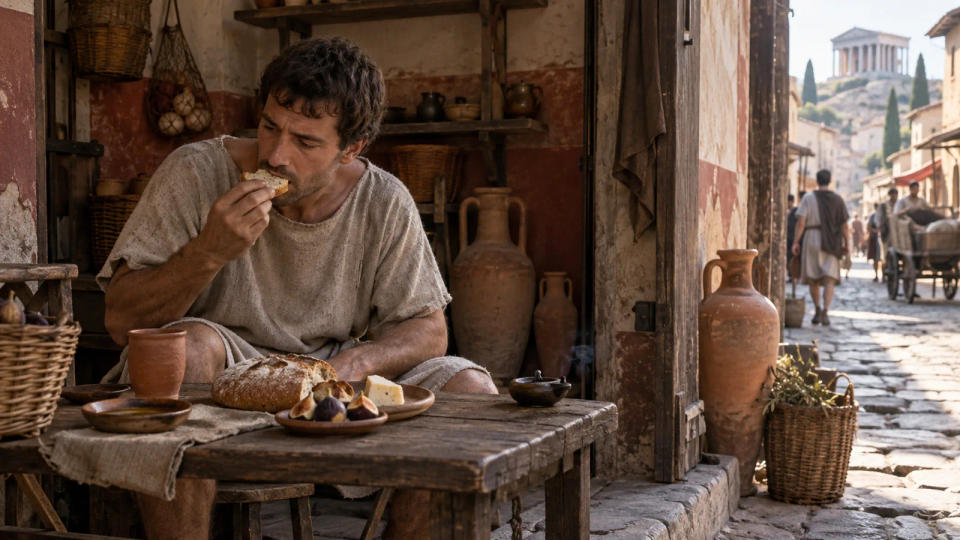
Romans called the morning meal ientaculum, but there was no universal breakfast menu across the empire. In an urban household, a practical start to the day might involve bread with cheese, olives, or fruit. A worker could eat quickly before heading to a shop, workshop, building site, market, or patron's house.
Bread deserves special attention. Grain was fundamental to Roman food supply, and archaeological finds show just how central baking could be. A carbonized loaf from Herculaneum was found still inside an oven, frozen in time by the eruption of Mount Vesuvius in AD 79. Pompeii has also produced carbonized loaves and large mills used to grind cereals.
Porridge had an older place in Roman food culture as well. Grain could be cooked into thick dishes rather than baked, especially where household equipment, money, or local habits made that more practical. Literary sources also describe simple combinations of bread, cheese, garlic, herbs, vinegar, and olive oil. These should not be treated as a fixed national breakfast, but they fit the broader evidence for inexpensive, filling foods built around grain and local produce.
Lunch Could Be Bought on the Street
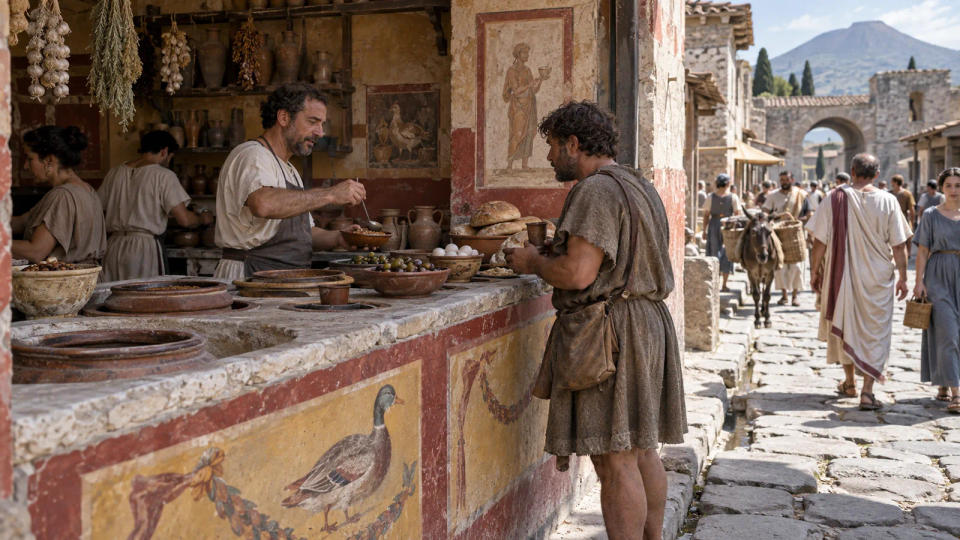
The midday meal, usually called prandium in the imperial period, was often lighter than the main meal of the day. In cities, it did not always come from a private kitchen.
Pompeii preserves dozens of thermopolia, food-and-drink shops with masonry counters and large jars set into them. The Archaeological Park of Pompeii notes that eating the midday meal outside the home was common among middle- and lower-class customers. Surviving shops indicate the sort of foods that could be served quickly: legumes or cereal-based dishes, bread, olives, eggs, cheese, and wine.
This street-food culture makes sense in crowded towns. Many people lived in spaces with limited cooking facilities, while craftsmen, merchants, laborers, travelers, and shoppers spent much of the day away from home. A hot bowl and some bread from a nearby counter could be the Roman equivalent of grabbing an inexpensive lunch during a busy workday—although the exact menu changed from shop to shop.
The Everyday Pantry Was More Varied Than the Banquet Stereotype
If grain supplied the calories, pulses supplied an important second pillar. Lentils, beans, chickpeas, peas, and lupines appear in Roman literary and archaeological evidence. Olive oil added fat and flavor. Fresh or dried fruit, nuts, leafy vegetables, herbs, and cheese could broaden a meal without turning it into a luxury feast.
A remarkable early third-century CE papyrus from Roman Egypt reads almost like an ordinary shopping note. It asks for poultry, bread, lupines, chickpeas, kidney beans, and fenugreek. The document is useful precisely because it is so mundane: it shows that everyday Roman food cannot be reduced to one Italian menu. The empire stretched across climates and food traditions from Britain to Egypt and the eastern Mediterranean.
Herculaneum adds even richer evidence. Analysis of sewer material from a shop-and-apartment block identified a wide range of edible plants, fish, shellfish, and other remains. The study counted 114 edible taxa among the material examined. That does not mean every resident ate all of them, or that every Roman town had the same variety, but it challenges the old idea that people of moderate means necessarily survived on a nutritionally poor, monotonous diet.
Dinner Was the Main Meal—but Usually Not an Imperial Feast
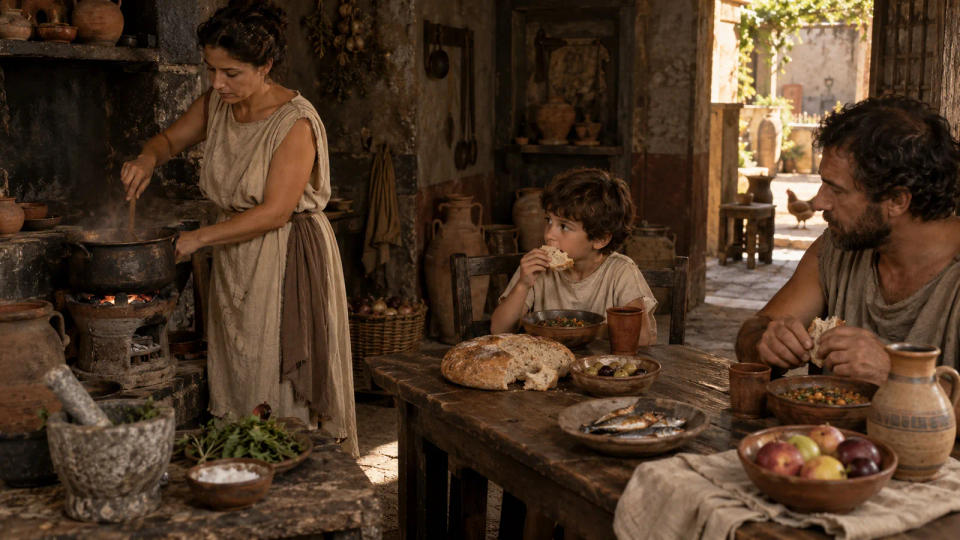
The main meal was cena. Its timing shifted across Roman history, so it is safer to think of it as the day's principal meal rather than assign one rigid modern clock time. For an ordinary household, dinner could bring together bread, a pulse or vegetable dish, olives, cheese, fruit, and perhaps fish. Meat was available, but daily access varied greatly with wealth, location, market supply, and religious or social occasions.
Fish sauce—often discussed under the name garum—was a recognizable Roman seasoning, and wine was commonly diluted with water. These familiar tastes crossed social boundaries, even if quality and quantity differed. What separated a wealthy banquet from an ordinary dinner was less the existence of bread, wine, fish, or fruit than the abundance, rarity, presentation, and number of courses.
This is why the famous Roman cookbook associated with Apicius can mislead when used by itself. Its elaborate sauces and showy dishes tell us much about elite culinary culture, but they are not a diary of what a shopkeeper, laborer, freedperson, or small farmer ate every evening.
The Roman Meal Was Simpler Than the Banquet Myth
So what did ordinary Romans eat on a typical day? A reasonable reconstruction begins with bread or another grain food, adds pulses, vegetables, olives, fruit, cheese, and oil, then varies the meal with fish, eggs, meat, or purchased street food depending on circumstance. Breakfast and lunch were often modest; cena was usually the main meal.
But “typical” should never become “identical.” Isotope research on people who died at Herculaneum has even found differences in access to marine and terrestrial foods within the same community. Roman diet changed with class, gender, geography, season, and personal means. The most revealing Roman table, then, is not the emperor's banquet. It is the ordinary one: a loaf of bread, a bowl of something warm, a few local foods, and just enough variety to remind us that daily life in Rome was more complex than the clichés.
Sources & Further Reading
- British Museum — Historical city travel guide: Rome, 1st century AD
- Archaeological Park of Pompeii — Thermopolium of Regio V
- University of Oxford — Roman diet and nutrition in the Vesuvian region
- University of Cambridge — High-resolution dietary reconstruction of Herculaneum victims
- The Metropolitan Museum of Art — Papyrus letter in Greek, early 3rd century CE
- British Museum — Making 2,000-year-old Roman bread