
A late-16th-century London street could carry more than carts and pedestrians. Food scraps, ashes, animal dung, muddy runoff, and the contents of chamber pots all had to go somewhere in a city that had no modern sewer network.
Tudor Londoners did not simply ignore the problem. They relied on privies and cesspits, specialist workers who emptied them at night, ward rakers who collected household refuse, carts that carried waste away, and rules intended to keep streets and waterways usable. The system was real, organized in places, and still frequently overwhelmed.
Tudor London Had Waste Services—Just Not Modern Sanitation
It is tempting to imagine Tudor London as a city where everyone threw rubbish into the street and nobody cleaned it up. The reality was more complicated. Inside the City of London, civic authorities had long appointed officials to supervise street cleaning. Research on early Tudor London shows that ward rakers were supplied with carts and horses, and by the 16th century they collected household waste at appointed times, reportedly three times a week.
That mattered because London generated a remarkable mix of refuse. Homes produced ashes, broken pottery, food remains, and sweepings. Markets added spoiled produce and packaging materials. Horses and livestock left dung in the roads, while butchers created bones, blood, offal, and other trade waste. City rules tried to control where this material could be left, and some waste was carried to designated dumping grounds outside the busiest streets.
But regulation did not mean cleanliness by modern standards. Narrow lanes, rapid population growth, uneven enforcement, and the sheer volume of human and animal activity meant that filth could accumulate quickly. Tudor sanitation was therefore less a single “system” than a patchwork of household habits, paid labor, civic rules, and convenient dumping places.

Chamber Pots, Privies, and Cesspits Handled Human Waste
For human waste, the basic technology was simple. A household might use a privy, sometimes called a jakes or garderobe, connected to a cesspit. The pit collected waste until it needed to be emptied. Wealthier properties could have indoor facilities, but even those toilets might be shared by several people or several households.
Private toilets were not available to everyone. London Museum records that in 1579 the 85 residents of All Hallows, near the Tower of London, had only three private toilets between them. Public privies therefore remained important, especially in crowded neighborhoods.
Chamber pots became increasingly common from the mid-16th century. Most were made from ceramic or pewter, although richer households could own more expensive versions. They were useful at night, when going outside to a privy was inconvenient or unsafe. In the morning, their contents might be emptied into a cesspit, a nearby stream or channel, or sometimes directly into the street.
This could create serious disputes. Cesspits placed too close to walls could leak into neighboring buildings, while shared privies raised awkward questions about who should pay for repairs and cleaning. Surviving records show that Londoners took those responsibilities seriously because a neglected cesspit was not merely unpleasant—it could damage timber, masonry, cellars, and relationships with the people next door.

Gong Farmers Did the Worst Job After Dark
When a cesspit filled, somebody had to climb in, shovel out the contents, and carry them away. In Tudor usage, a worker doing this could be called a gongfermour, or gong farmer. Historic England notes that these workers handled human excrement from privies and cesspits and generally worked at night, which is why they were also associated with the name “nightmen.”
The work was dirty, physically demanding, and hazardous. A cesspit could be cramped, slippery, poorly ventilated, and full of decomposing waste. Workers used buckets, shovels, baskets, and carts, moving the material when streets were quieter and fewer people would be exposed to the smell. Rules also restricted when excrement could be carried through the city.
Human waste was not always treated as worthless. Material removed from pits could be taken beyond the city and used as fertilizer, turning an urban nuisance into something with agricultural value. This was one reason waste removal could function as a trade rather than simply a public service.
Even royal life did not eliminate the problem. Historic Royal Palaces notes that Tudor courts periodically moved between residences partly so palaces could be cleaned and accumulated human waste removed. Hampton Court may have been far grander than an ordinary London house, but it still depended on laborers and physical removal rather than a modern sewer.

Garbage Ended Up in Streets, Ditches, and Waterways
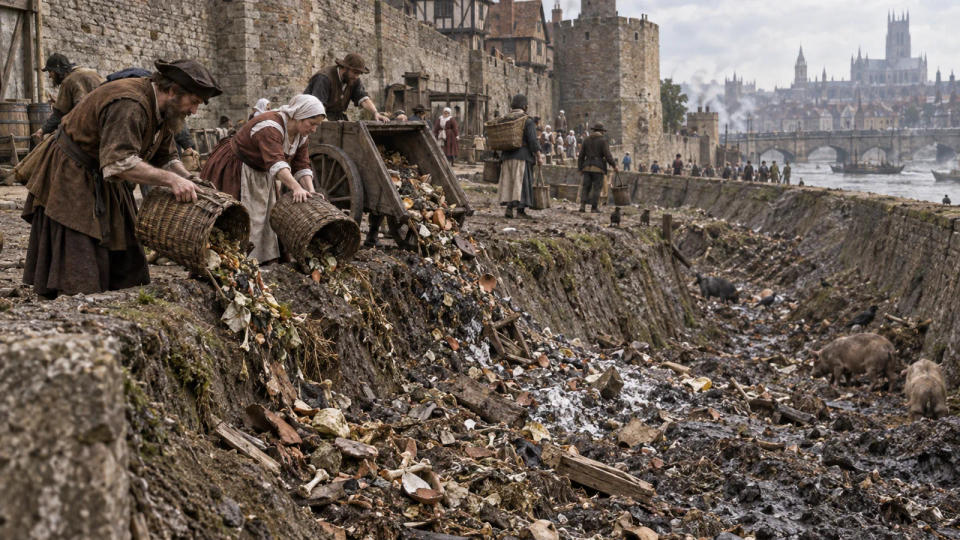
Household collection and street cleaning did not prevent illegal or informal dumping. Convenient empty spaces attracted rubbish, especially where old defensive structures were no longer useful. Archaeology at St Bartholomew’s Hospital showed that London’s city ditch had repeatedly been repaired and recut through the medieval period, but by the late 16th century maintenance declined and large quantities of rubbish were dumped into it.
That rubbish is valuable evidence today. Archaeologists recover broken pots, leather shoes, animal remains, construction debris, and discarded household objects from such deposits. They reveal what written rules cannot: what people actually threw away and where it accumulated.
Trade waste was another problem. Excavations near Charterhouse and Smithfield have uncovered material linked to butchers working in the area during the late 16th century. Elsewhere, pipes, channels, ditches, and streams could become blocked with animal dung, household rubbish, and human waste. Some material eventually reached larger waterways, including the Thames.
Yet not every scrap went straight to the river. Carts, rakers, designated dumping grounds, reuse, and resale all formed part of London’s waste economy. Ashes, manure, and other organic material could have value outside the city. Tudor London was dirty, but it was not a place where people had no idea that waste needed to be moved.
What Archaeology Reveals About the Smellier Side of Tudor Life
Cesspits and rubbish deposits are among the most revealing archaeological features in early modern London because they preserve ordinary objects that rarely appear in royal portraits or political records. Ceramic chamber pots, food remains, seeds, animal bones, broken household goods, and scraps from trades can survive together in the same deposit.
London Museum notes that some chamber pots have been recovered from old cesspits, apparently dropped or discarded there with other household waste. Archaeologists can also study plant remains from these pits to reconstruct diet and everyday habits. MOLA’s work around Tudor London has similarly shown how refuse from markets, homes, and trades can illuminate the lives of ordinary people.
The evidence also corrects a common stereotype. Tudor London certainly had foul smells and serious sanitation problems, but it was not completely unmanaged. There were collectors, carts, regulations, shared responsibilities, public privies, cesspits, and specialized workers. The trouble was scale: a rapidly growing city was producing more waste than these labor-intensive methods could comfortably handle.
That is the most useful way to picture Tudor sanitation. Londoners had practical solutions, but every solution still required somebody to carry, shovel, sweep, cart, or dump the waste by hand.
In short: Tudor London dealt with garbage and human waste through a mixture of collection, storage, reuse, and dumping. It was an organized but imperfect urban system—one that kept the city functioning while leaving plenty behind for archaeologists to discover centuries later.
Sources & Further Reading
- London Museum — Early modern London’s sewage problems
- Historic England — Reconstruction of a medieval gongfermour, or gong farmer
- University of Oxford Research Archive — Political Culture and Urban Space in Early Tudor London
- MOLA — Excavating the London city ditch at St Bartholomew’s Hospital
- MOLA — Crossrail excavation offers glimpse into daily life of Tudor Londoners
- Historic Royal Palaces — The royal court in the Tudor period