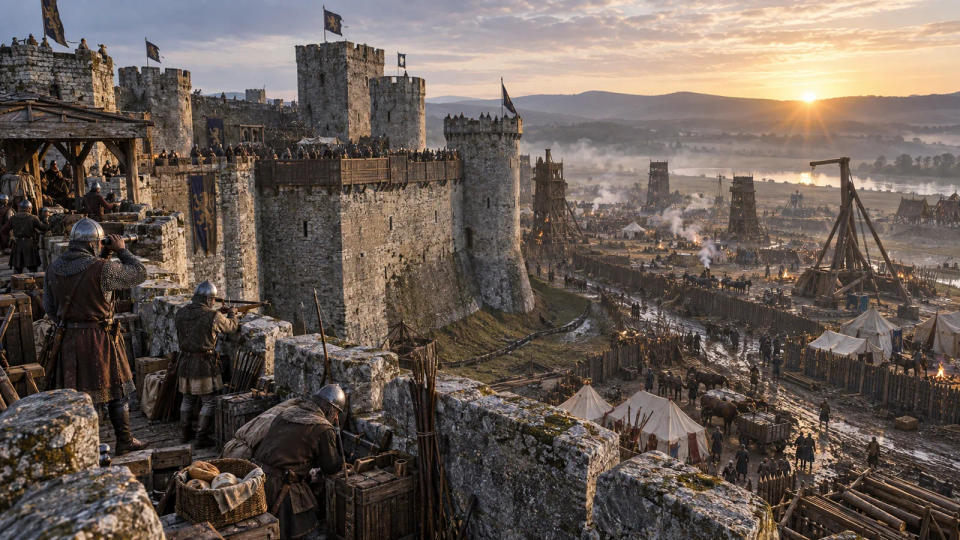
What happened after the gates slammed shut and an enemy army settled in outside for weeks or even months? Medieval soldiers survived long sieges less through constant fighting than through preparation: stockpiled food, protected water, strict use of supplies, repairs, guard duty, sanitation, and the hope that either relief would arrive or the besiegers would give up first.
No single siege represents all of medieval Europe, and the surviving evidence is uneven. English and Welsh castles are especially well documented, however, and they show the same basic pressures that shaped siege survival elsewhere: a fortress could be strong enough to resist assault and still be defeated by hunger, disease, damaged defenses, or failing morale.
Survival Started Before the Gates Closed
A castle that expected attack had to become a warehouse as much as a fortress. Defenders gathered grain, preserved food, drink, firewood, arrows, crossbow bolts, stones, timber, and other materials before the enemy completed a blockade. English Heritage notes that non-combatants could be evacuated when there was time, reducing the number of mouths that had to be fed. Wells and cisterns were checked, weapons positioned, and repair materials stored where they could be reached quickly.
The siege of Kenilworth Castle in 1266 shows how much preparation mattered. By the time Henry III's forces arrived, the castle held more than 1,200 people, including soldiers, servants, women, and children, and had accumulated enough food to resist for months. The siege ultimately lasted 172 days, one of the longest in medieval England. That did not mean the defenders enjoyed comfortable reserves. Every additional person inside increased pressure on stores, water, sleeping space, and sanitation.
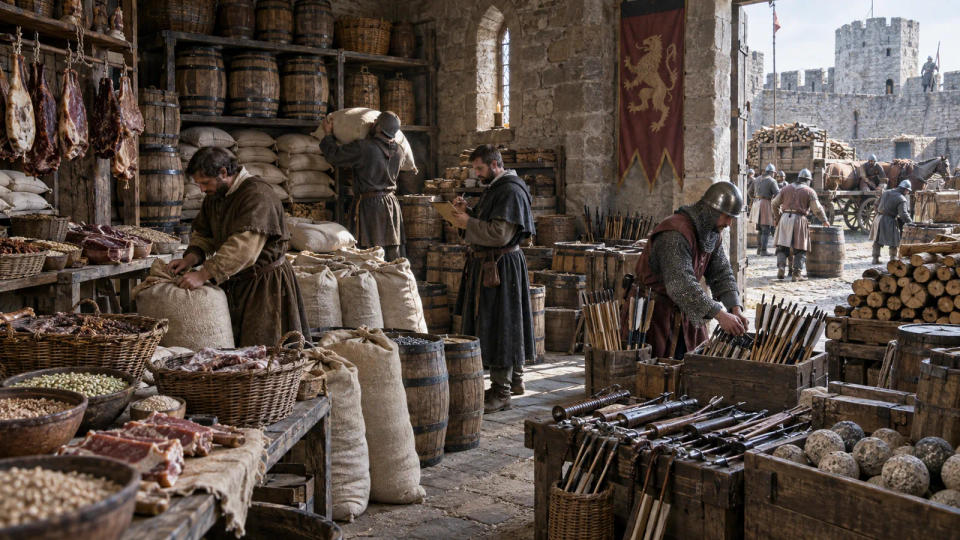
Rationing was therefore a military decision. Food that might have been ordinary in peacetime became strategic inventory. Grain and dried or salted provisions could last far longer than fresh meat or vegetables, while animals inside the walls consumed fodder of their own. A commander who used supplies too freely in the first weeks could discover that the castle's strongest walls were useless once the stores were empty.
Water Could Decide the Siege
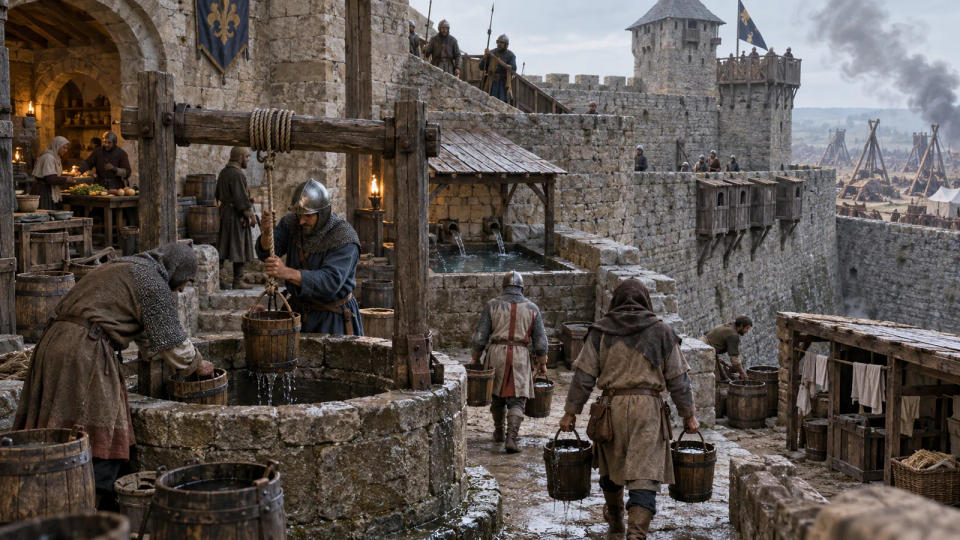
Food shortages might take weeks to become critical; lack of water could become dangerous much faster. Many castles relied on internal wells or cisterns that collected rainwater, precisely because an outside spring or stream could be cut off or contaminated. At Criccieth Castle in Wales, for example, Cadw identifies a spring-fed cistern inside the entrance passage that supplied fresh water to the castle.
Keeping that supply usable was a daily job. Water had to be drawn, carried, rationed, and kept as clean as circumstances allowed. A crowded wartime garrison created more waste than a peacetime household, while wounded soldiers, animals, cooking, washing, and firefighting all competed for water. Medieval people did not understand microbes in modern terms, but they knew from experience that foul water and filthy surroundings could be dangerous.
Disease could finish what siege engines failed to do. At Kenilworth, the defenders were eventually weakened by dysentery as their food ran out. The case is a reminder that siege survival was not just a contest between walls and weapons. It was also a struggle to keep hundreds of people functioning in a confined space under worsening conditions.
Soldiers Had to Keep the Castle Alive, Not Just Fight
Most days in a long siege were not dramatic assaults. Soldiers still had to watch walls and gates, rotate sentries, move missiles, guard vulnerable points, and respond whenever attackers tested the defenses. At the same time, laborers and soldiers repaired damage. English Heritage describes defenders storing timber, stone, and earth for exactly this purpose, along with arrows, bolts, and stones for counterfire.
Mining created another threat. Attackers could tunnel beneath a wall, prop the cavity with timber, and burn the supports so that masonry collapsed. Defenders might dig countermines to intercept them. When Prince Louis's forces undermined a gatehouse tower at Dover Castle in 1216, the collapse did not end the defense. The garrison created a new barrier behind the breach from boulders, heavy timber beams, and oak posts, turning a destroyed section into another obstacle.
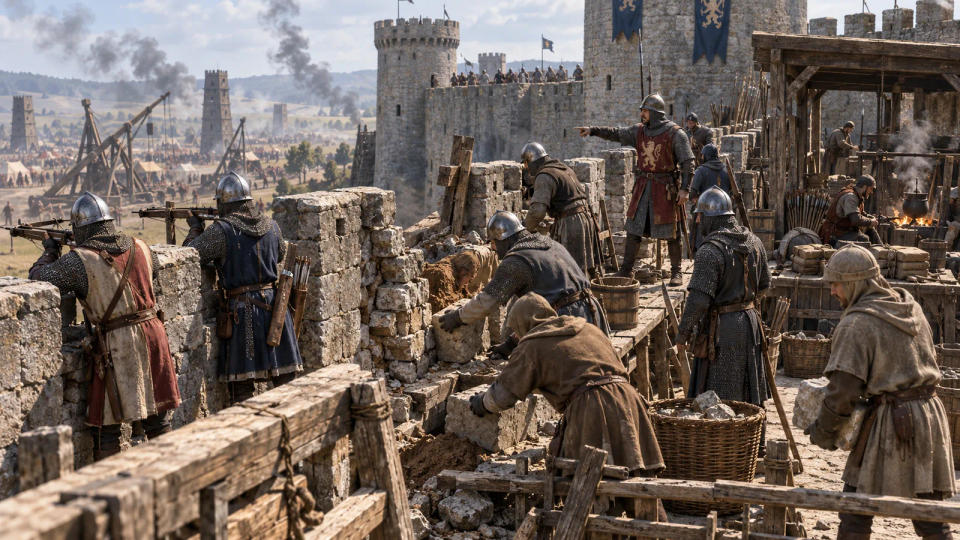
That kind of work explains why endurance depended on organization as much as courage. A garrison needed people who could shoot, haul, build, cook, carry water, care for animals, move the wounded, and stay awake on watch. A castle was a defensive machine, but the machine only worked while exhausted people could keep its many small systems running.
Hunger, Disease, and Negotiation Set the Limit
Attackers understood that time could be a weapon. If direct assault failed, they could try to seal roads and gates, stop supplies and reinforcements, and wait for the defenders' condition to deteriorate. That approach was costly for the besiegers too. A large army outside the walls needed food, pay, animals, ammunition, shelter, and replacement equipment. At Kenilworth, at least 20 English counties were required to supply Henry III's army, showing how a siege could strain the countryside far beyond the castle itself.
Rochester Castle in 1215 shows the combination of physical attack and starvation. King John's forces bombarded the castle and undermined a corner of the great keep, forcing the rebels into the surviving part of the building. They still resisted, but hunger eventually compelled them to surrender. At Kenilworth half a century later, the garrison held out for nearly six months; when it finally submitted in December 1266, English Heritage reports that only about two days' food remained and dysentery had badly weakened the defenders.
Surrender, then, was not necessarily proof that soldiers had stopped fighting. It could be a calculated decision made when continued resistance had no realistic purpose. Negotiated terms might allow members of a garrison to leave with arms, horses, or personal possessions, although conditions varied greatly from one siege to another. Commanders had to weigh honor, orders, relief prospects, remaining supplies, and the danger of an assault if negotiations failed.
The most successful defenders therefore survived by stretching time. They rationed food, protected water, repaired damage faster than the attackers could exploit it, controlled access to scarce resources, and maintained enough discipline to keep the fortress functioning. If a relief army arrived, the enemy ran short of money or supplies, or political circumstances changed, simply remaining inside the walls could become a victory. Endurance was measured in meals, buckets, repair shifts, and sleepless watches as much as in successful attacks.
Conclusion
Months-long medieval sieges were endurance contests disguised as battles. The decisive tools were often not swords or trebuchets but grain stores, wells, timber, sanitation, labor, and discipline. Stone walls bought defenders time; survival depended on how well they used it.
Sources & Further Reading
- English Heritage — Medieval Siege Warfare
- English Heritage — The Siege of Kenilworth Castle
- English Heritage — History of Rochester Castle
- English Heritage — The Great Siege of Dover Castle, 1216
- English Heritage — 10 Things You Probably Didn't Know About Sieges
- Cadw — Castell Cricieth Custodian Tips