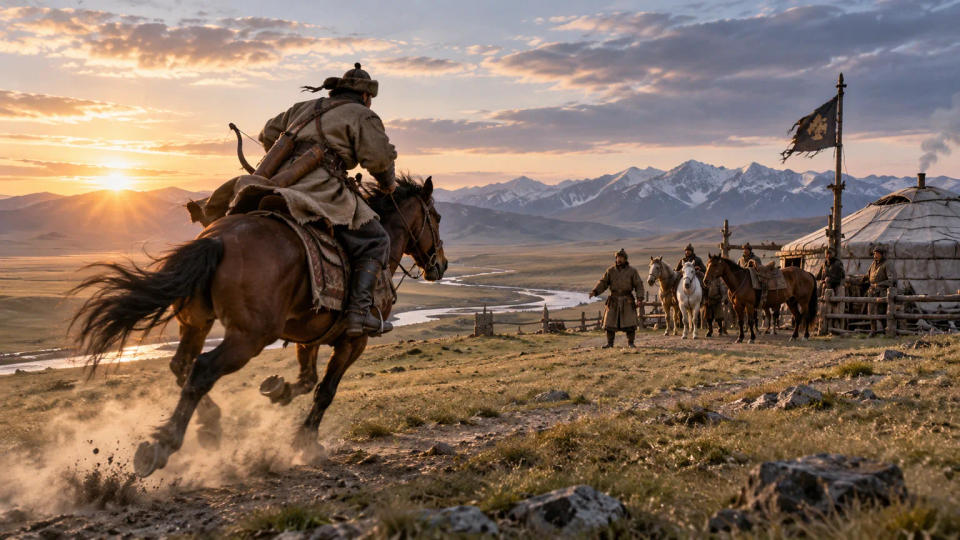
How could an order from a Mongol ruler travel across thousands of kilometers of steppe, mountain, desert, and farmland before the age of trains or telegraphs? The answer was not one impossibly fast rider. It was a carefully organized relay network, usually called the yam, that kept official messengers moving by giving them fresh horses, supplies, and recognized priority along major routes.
The system turned distance into a chain of manageable stages. Instead of pushing one exhausted horse from one end of the empire to the other, couriers could exchange mounts at staffed stations and continue with far less delay. Under Ögedei Khan in the 1230s, the Mongol state expanded and regulated this network on an imperial scale.
The Mongols Built Speed Around Fresh Horses
Horses were already central to Mongol warfare, hunting, herding, and travel, so the empire possessed a deep culture of skilled riding and horse management. The breakthrough was administrative: the state organized these strengths into fixed routes with places where authorized travelers could find remounts and provisions.
The Secret History of the Mongols, as discussed by modern historians, credits Ögedei with ordering post stations so messengers could travel quickly without constantly burdening ordinary settlements. Local military and administrative units were assigned responsibilities for supplying stations with horses, food animals, carts, and personnel. The details varied across regions, but the principle was simple: a courier arriving on a tired horse should not have to stop for long.

This mattered because a horse could be fast for a limited stretch but could not maintain a hard pace indefinitely. A network of replacement mounts allowed the message to keep moving even when individual animals needed rest. The speed belonged to the system as much as to the rider.
A Relay Station Was More Than a Place to Change Horses
A functioning post station needed people, animals, fodder, food, storage, and some form of lodging or shelter. Later descriptions from the Yuan period present major routes as lines of stations where official travelers could rest, eat, and obtain new mounts. Marco Polo, whose account must be read cautiously because some of its figures are debated, described imperial post houses at regular intervals on roads leading from the Great Khan's capital.
Station spacing was not identical everywhere. Geography, population, political control, and the importance of a route all affected how the network worked. Academic research on the Golden Horde and western Asia shows that the postal organization adapted to local conditions rather than following one perfect empire-wide blueprint.
The stations also helped solve a political problem. Before tighter regulation, messengers and officials could requisition animals and provisions directly from communities, creating opportunities for abuse. By channeling official travel through designated stations, Mongol rulers tried to make communication faster while placing clearer limits on who could demand resources.
The Paiza Told People Who Had Priority
Speed depended on more than horses. A courier also needed authority. Mongol rulers issued passes often known as paiza or paizi, physical signs that the bearer was traveling with official permission. The Metropolitan Museum of Art preserves a late thirteenth-century iron safe-conduct pass from Yuan China, inlaid with silver and inscribed in Phagspa script.
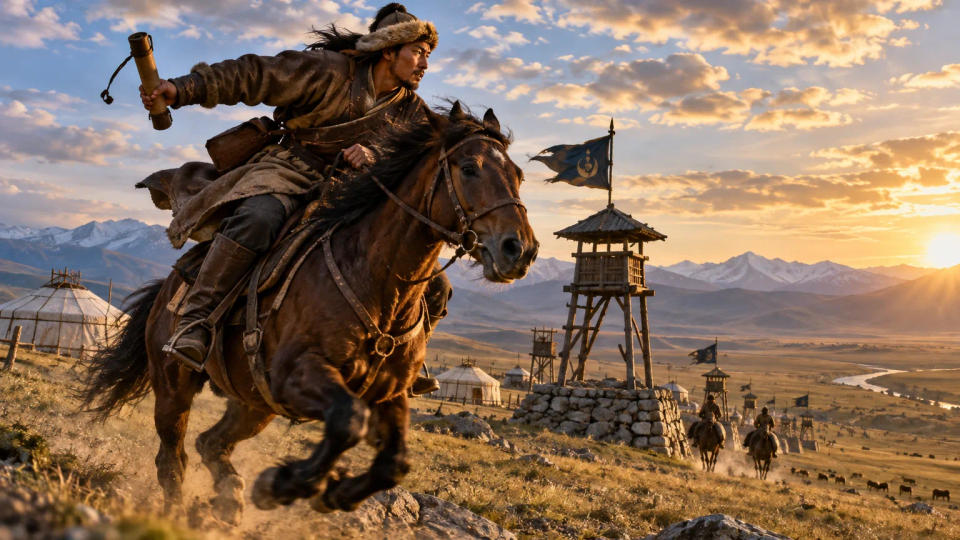
Such passes were not decorative souvenirs. They identified authorized travelers and helped them gain access to services reserved for imperial business. The exact privileges varied by rank, place, and period, and rulers repeatedly tried to curb unauthorized use. That need for regulation tells us how valuable access to the relay network could be.
For a messenger, recognized status reduced friction. He did not need to renegotiate every horse change from scratch. Station staff could see that the journey carried official weight and prepare the next stage accordingly.
How Fast Could a Mongol Message Actually Travel?
There was no single speed for every journey. Roads deteriorated, rivers flooded, mountains slowed riders, winter changed routes, and horses were not equally available everywhere. A government dispatch crossing a well-served corridor could move far faster than an ordinary traveler carrying baggage.
Still, the network could produce striking results. The Metropolitan Museum of Art notes that a letter sent from the emperor in Beijing to the Ilkhanid capital at Tabriz—roughly 5,000 miles away—could make the journey in about a month when carried through the relay system by an authorized envoy. That figure should be understood as an illustration of what the organized network could achieve, not as a guaranteed timetable for every message.
In western Asia, reforms under the Ilkhan Ghazan at the end of the thirteenth century sought to tighten the postal service, restrict official stations to legitimate couriers, and ensure that horses were ready. Sources from this period also show a difference between the ideal speed promised by regulations and the slower reality sometimes recorded in practice.
Why the Yam Mattered to the Mongol Empire
The Mongol Empire was too large to govern by personal presence alone. Rulers needed reports from distant provinces, military commanders needed orders, envoys needed safe routes, and officials had to move information between courts separated by enormous distances. The yam acted like connective tissue between political centers.

It also served travelers beyond the immediate delivery of orders. Diplomatic missions and authorized officials could use the same infrastructure, and the broader security created by Mongol rule helped people, goods, and ideas move across Eurasia. The system did not erase danger or make every road safe, but it gave the imperial government a communications advantage that matched the scale of its conquests.
The most important point is easy to miss: Mongol messengers were not superhuman riders racing nonstop across a continent. Their speed came from logistics. Fresh horses were waiting. Staff knew their roles. Official passes opened access. Routes linked one station to the next. The empire made fast communication possible by organizing thousands of ordinary tasks into one extraordinary network.
Conclusion
The Mongol yam was fast because it treated communication as infrastructure. Riders still faced weather, terrain, fatigue, and imperfect administration, but a chain of prepared stations let urgent messages travel much farther and faster than one horse ever could. For an empire stretched across Eurasia, that network was not a convenience. It was part of how distant territories could remain connected at all.
Sources & Further Reading
- The Metropolitan Museum of Art — The Legacy of Genghis Khan
- The Metropolitan Museum of Art — The World of Khubilai Khan: Travel
- Columbia University, Asia for Educators — Marco Polo and the Khan's Posts
- Golden Horde Review — Postal Organisation (Yam) in the Golden Horde
- Encyclopaedia Iranica — ČĀPĀR