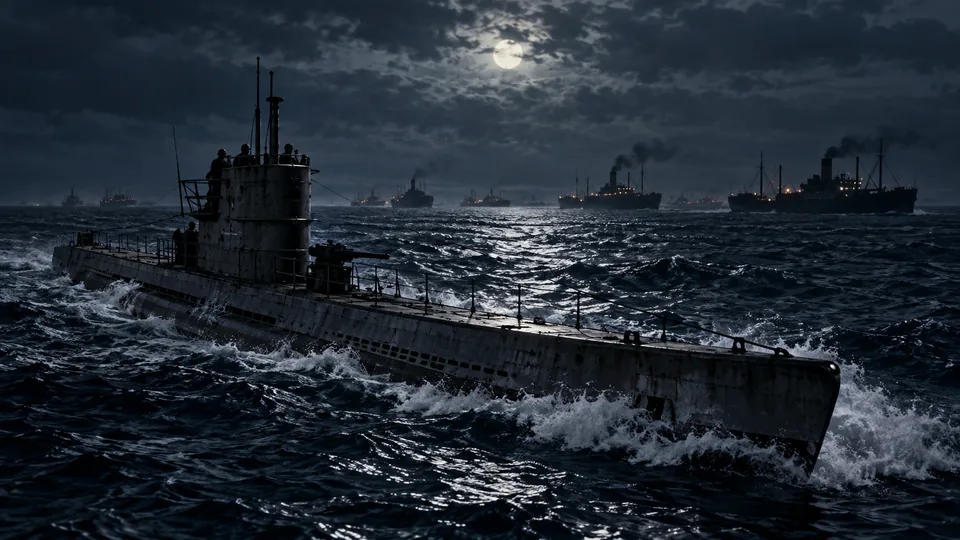
For sailors in an Atlantic convoy, danger could arrive with almost no warning: a flash, a violent detonation, and a ship that had been part of the formation moments earlier could be burning or sinking. German U-boats were feared not because they were invincible, but because they were difficult to find, could strike by surprise, could gather in groups against a convoy, and were aimed at the shipping lifeline on which Britain and the wider Allied war effort depended.
That combination turned the North Atlantic into a battlefield of uncertainty. Merchant crews knew escorts were nearby, yet they also knew a submarine might already be tracking them from beyond the visible horizon.
The Threat Was Hard to See Until It Struck
A U-boat's greatest advantage was not heavy armor or overwhelming firepower. It was concealment. A submarine could spend much of a patrol searching on the surface, where its diesel engines gave it better speed and range, then dive when threatened or when conditions favored an underwater attack. At night, especially early in the war, a low silhouette could be extremely difficult to spot among waves and darkness.
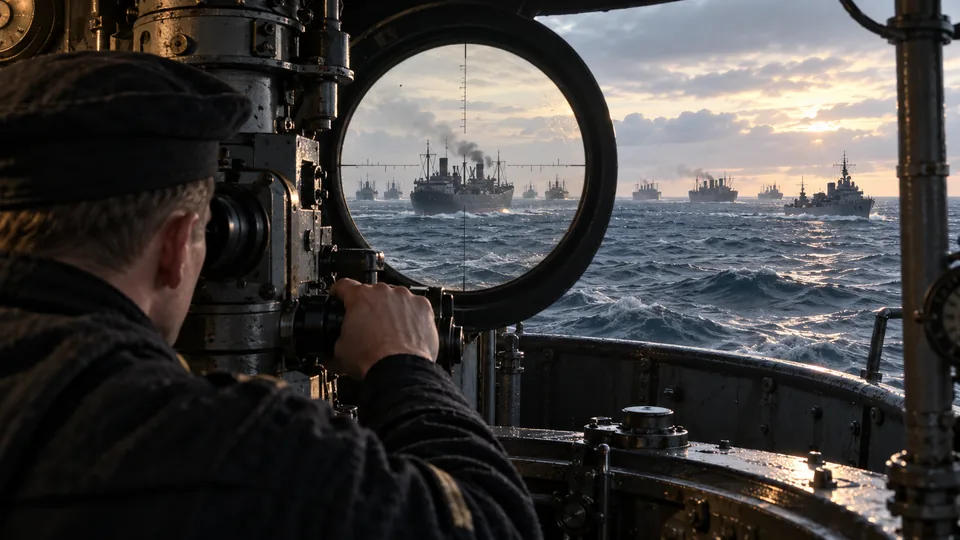
Detection technology existed, but it was not magical. Allied ASDIC—an early form of sonar—helped escorts search for submerged submarines, yet finding and holding contact with a moving U-boat in rough seas was difficult. Radar, air patrols, better training, and improved tactics would make the submarine increasingly vulnerable, but those systems were unevenly available in the first half of the war.
That uncertainty mattered psychologically. A destroyer crew might know an enemy submarine was nearby without knowing exactly where it was. Merchant sailors often had even less information. A torpedo could be the first unmistakable sign that the convoy had been found.
Wolf Packs Turned One Sighting Into a Convoy Battle
Grand Admiral Karl Dönitz's submarine command developed a system designed to exploit the enormous size of the Atlantic. U-boats were spread across patrol lines. When one boat found a convoy, it could report the contact by radio and shadow the ships while headquarters directed other submarines toward the same target. The result was the tactic the Allies called a "wolf pack."
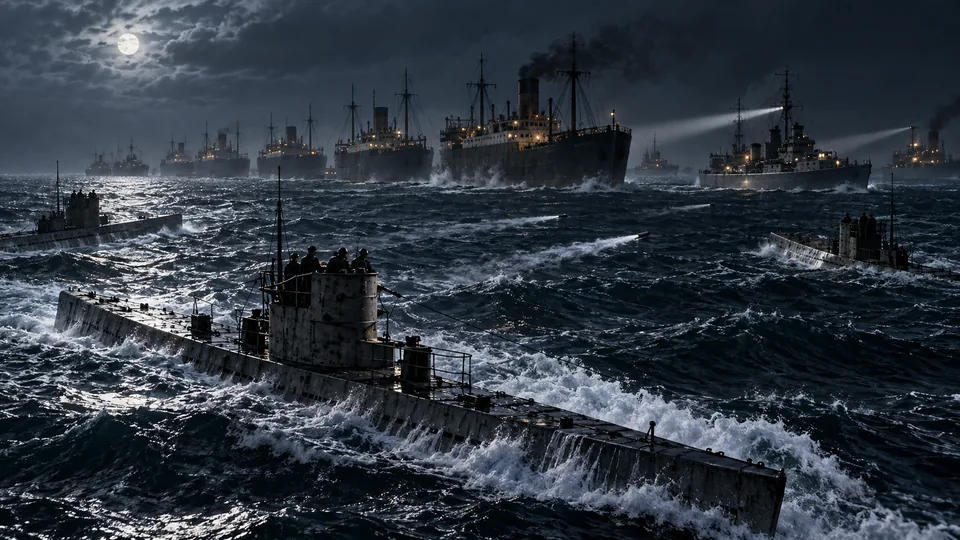
This made convoy defense especially demanding. Escorts could drive off one attacker only to find another approaching from a different direction. Night surface attacks were particularly troublesome because a surfaced U-boat was fast enough to maneuver around a convoy and could be harder for early anti-submarine sensors to detect than a submerged target.
The system also created a weakness for the Germans. Wolf-pack operations depended heavily on radio. Allied high-frequency direction finding, or HF/DF—often called "Huff-Duff"—could take bearings on U-boat transmissions. Intelligence from intercepted and, at times, decrypted German naval communications also helped the Allies understand where submarine groups were operating. What initially helped coordinate attacks eventually helped reveal the attackers.
The Real Target Was Britain's Lifeline
The fear surrounding the U-boats was strategic as well as personal. Britain was an island economy fighting a global war. Food, fuel, weapons, raw materials, troops, and equipment had to cross the sea. Germany did not need to invade every convoy. It needed to sink enough shipping to strain that flow faster than the Allies could protect or replace it.
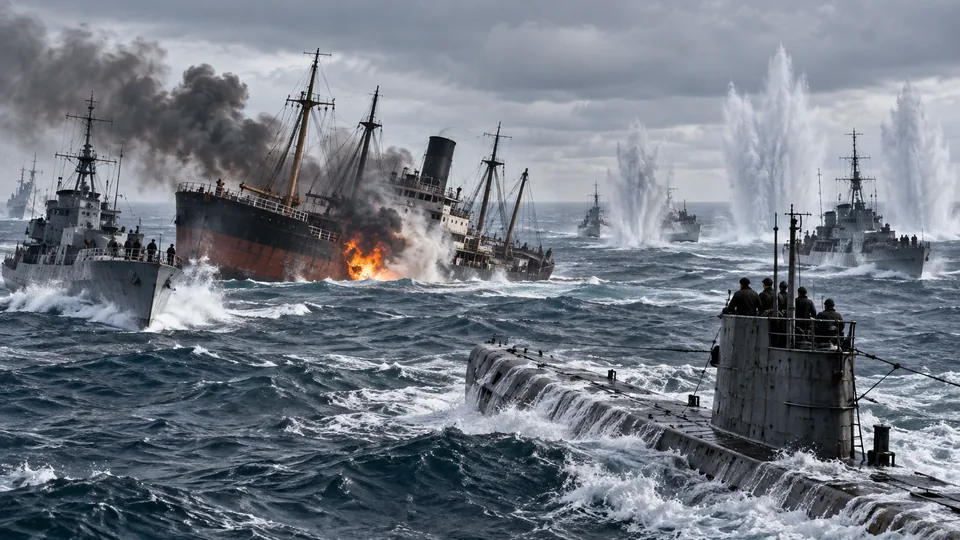
That danger became painfully clear in several phases of the campaign. After the United States entered the war, U-boats attacked shipping off the American East Coast in early 1942. The U.S. Navy's historical account notes that more than 80 merchant ships were sunk off the East Coast from January through April, with another 55 lost in the area north of Bermuda. Convoys and stronger air and naval patrols eventually reduced the opportunity there, but the submarines shifted to other weakly protected routes.
The wider cost of the Atlantic campaign was enormous. The U.S. Naval History and Heritage Command records about 3,500 Allied merchant ships and 175 Allied warships sunk between 1939 and 1945, along with more than 72,000 Allied naval and merchant seamen killed. Not every loss was caused by a U-boat, but submarines were the central threat around which much of the Atlantic struggle revolved.
For Allied leaders, this was therefore more than a contest between submarines and escorts. If the shipping routes failed, armies could not be supplied and Britain's ability to continue the war would be endangered. That is why defeating the U-boat campaign became one of the Allies' highest strategic priorities.
Why the U-Boat Menace Broke in 1943
The turning point was not a single wonder weapon. It was the combination of better escorts, improved radar, HF/DF, more effective anti-submarine tactics, intelligence, escort carriers, and long-range aircraft. These improvements steadily reduced the areas in which U-boats could operate with relative freedom.
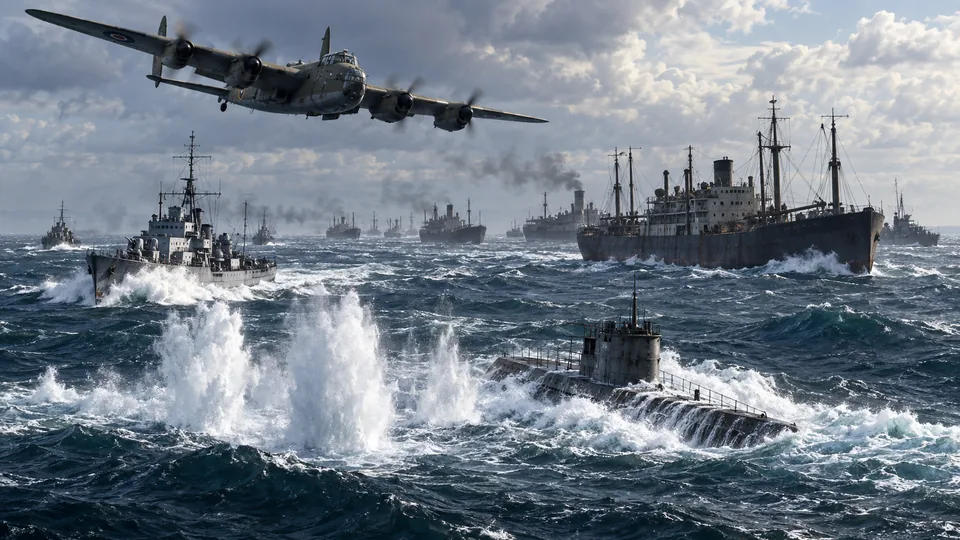
One of the most important changes was the closing of the mid-Atlantic air gap. Long-range Liberator aircraft and escort carriers extended air cover into waters that had once been beyond the reach of land-based patrol aircraft. A U-boat that surfaced to recharge batteries or move quickly could now be surprised by aircraft far from shore. Darkness was also becoming less protective as airborne radar and the Leigh Light made night attacks on surfaced submarines increasingly practical.
May 1943 became a decisive shock for the German submarine force. Allied escorts and aircraft inflicted losses severe enough that Dönitz temporarily withdrew many U-boats from the North Atlantic convoy routes. The campaign did not end—Germany introduced new torpedoes, radar-warning equipment, heavier anti-aircraft defenses, and later snorkels—but the balance had changed.
The reversal also shows why the early fear was rational without making the U-boats supernatural. They had exploited gaps in escort strength, air coverage, sensors, coordination, and training. Once the Allies linked technology, intelligence, mass production, air power, and experienced escort groups into a stronger system, the same submarines faced a much more dangerous ocean. U-boat crews themselves ultimately suffered catastrophic losses.
Conclusion
German U-boats were feared in the Battle of the Atlantic because they combined stealth, surprise, coordinated pack tactics, and a target of enormous strategic value: Allied merchant shipping. A single submarine could force an entire convoy into hours of evasive maneuvering and anti-submarine search; several could turn the crossing into a prolonged battle. Their threat was finally contained not by one invention, but by a network of convoys, escorts, aircraft, radar, sonar, direction finding, intelligence, training, and industrial capacity that made the Atlantic steadily less hospitable to the hunter.
Sources & Further Reading
- Royal Canadian Navy — The Battle of the Atlantic, 1939 to 1945
- Naval History and Heritage Command — Battle of the Atlantic: Overview
- Naval History and Heritage Command — "Black May": Battle of the Atlantic 1943
- Royal Air Force Museum — Coastal Command